
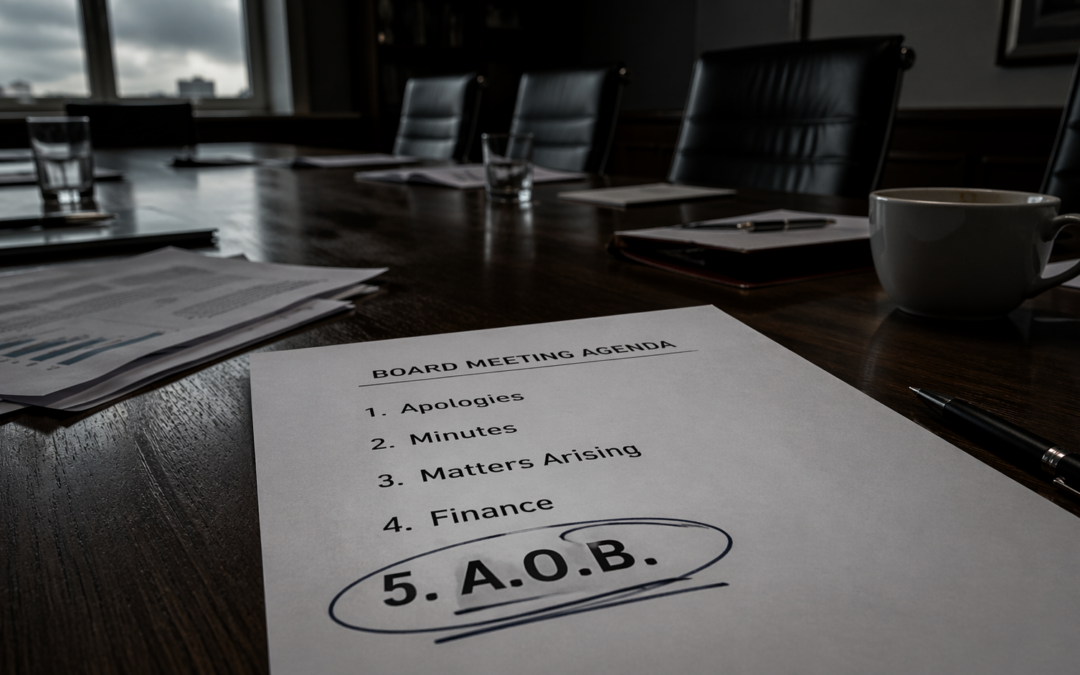
The three words that appear on every agenda. And the three words that can quietly undermine a meeting’s governance.
“Does anyone have any other business to declare?”
It is one of the most familiar lines in any boardroom. AOB sits at the end of the agenda and yet, in our experience, it is one of the most misused agenda items in governance.
Used well, it keeps meetings efficient and boards connected. Used poorly, it becomes a catch-all for decisions that deserved proper attention, and a space where accountability goes to die.
What AOB should be used for
AOB has a clear purpose. It exists for minor business updates or announcements that have arisen since the agenda was set, items a board member wishes to flag for discussion at a future meeting, and brief follow-ups or minor actions that do not warrant a standalone agenda item.
Five minutes. Perhaps a little more if needed. That is what AOB should require.
It is a housekeeping function, not a decision-making forum.
Where it goes wrong
The problem arises when AOB becomes a vehicle for something it was never designed to carry.
Significant items that require board approval, strategic discussions that demand preparation and careful deliberation, or sensitive matters that affect the whole organisation – none of these belong under AOB. When they appear there, the consequences are unpredictable: unclear outcomes, decisions made without full discussion, and a meeting that significantly overruns.
Governance clarity depends on items being heard in the right place, at the right time, with the right level of preparation. AOB, by its nature, offers none of that.
The strategic item
One of the most common misuses of AOB is the introduction of a strategic item at the very end of the meeting.
By this point, board members may be mentally disengaged, time is short, and there has been no opportunity for the board to review papers, seek advice, or form a considered view. A strategic decision made under these conditions is rarely a good one, and it places the board in an unnecessarily vulnerable position.
If an item is significant enough to shape the direction of the organisation, it is significant enough to earn its own place on the agenda. If it cannot wait until the next meeting, it should be woven into the original agenda, or a separate meeting arranged outside of the board with a follow-up at the next scheduled session.
How to decipher if your item belongs under AOB
Before raising something under AOB, it is worth asking: does this item require a decision? Does it involve risk, finance, or significant organisational change? Would board members benefit from having papers or background information in advance?
If the answer to any of those is yes, it does not belong in AOB.
Final thoughts
AOB is not unimportant. Used correctly, it provides a structured moment to tidy loose ends, surface emerging topics, and close the meeting with clarity. It is a small but valuable part of good governance practice.
The difficulty is that its informality makes it easy to exploit – not always deliberately, but often without realising the governance cost.
Effective boards treat AOB as what it is: a brief, minor segment with a specific purpose. Not a back door for decisions that deserve a proper hearing.