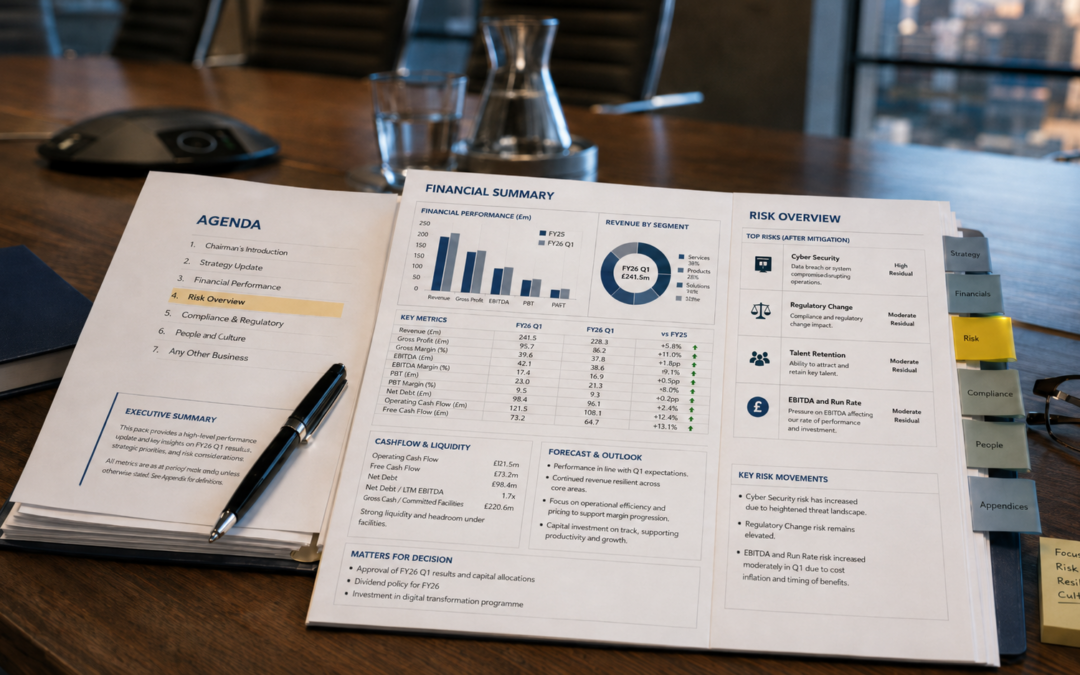
A board pack rarely changes by accident.
Recent research found that the average board pack now runs to 226 pages. That is a lot of information for any board to work through and a lot of places for something important to hide.
A supplementary finance paper issued later than expected. A new risk item appearing on the agenda. A longer CEO update than usual. A report that carries more caveats than conclusions. An agenda that shifts month after month, rather than following its usual rhythm.
Individually, these may look like routine administrative changes. Together, they can signal something more significant.
Because sometimes, the board pack is speaking before anyone in the boardroom is ready to say the words out loud.
The board pack should be used as a governance signal
A good board pack should give board members the information they need to understand performance, scrutinise risk and make informed decisions. It should support strategic discussion, while also providing clear operational updates.
It should not be a jumble of papers.
It should provide a clear view of where the organisation is, what has changed since the last meeting, what requires challenge and what decisions need to be made.
During periods of change, this becomes even more important.
Leadership transitions, financial pressure, audit scrutiny, and operational change can all alter the tone of a board pack. Reports become less routine. Actions carry more weight. Financial updates require closer attention. The minutes need to capture not only what was discussed, but what was challenged, agreed, and owned.
At this point, the board pack becomes more than a set of meeting papers.
It becomes a governance signal. The question is whether anyone is reading it that way.
When the rhythm changes
Most boards have a rhythm. We’re not talking about rhythm on the dancefloor; we mean order in what is being sent every month as the Board pack.
The same core reports appear each month or each quarter. Finance follows a familiar format. Risks are reviewed in a consistent way. Actions are tracked. Decisions are recorded.
That rhythm matters because it allows board members to notice when something has shifted.
A board pack that changes once may simply reflect a new reporting requirement or a one-off issue. But when the format, timing, or tone of the pack changes repeatedly, it is worth asking why.
A late paper may point to information that was still being finalised. A recurring risk may suggest that the organisation has not yet found the right solution. A finance report that becomes more detailed may indicate greater pressure on assumptions, cashflow or future planning.
The point is not that every change is a warning sign. But every change deserves to be questioned.
Board packs are often taken as read
That is not a problem in itself. Board meetings should not be used to read papers aloud. The purpose of the meeting is to discuss, challenge and decide.
But taking papers as read should not mean taking them at face value.
If a report highlights a risk, the board should understand the impact. If a finance paper shows pressure, the board should understand the assumptions behind it. If a decision is requested, the board should be clear on the options, the rationale, and the consequences.
Good governance is not about receiving information. It is about understanding it.
Where the board pack and minutes meet
The board pack and the minutes should work together.
The board pack shows what information was presented to the board. The minutes show how that information was discussed, challenged, and acted upon.
This becomes particularly important during periods of change or increased scrutiny. If an organisation is dealing with financial pressure, leadership changes, audit matters or sensitive operational issues, the audit trail becomes more important.
It is not enough for the board pack to contain the information.
The minutes need to show what the board did with it.
That does not mean recording every word. It means capturing the substance of the discussion, the challenge provided, the decision reached and the ownership of any agreed actions.
Final thoughts
The board pack is often seen as an administrative task. But it is much more than that.
Research by Board Intelligence indicates that less than half of board members feel board papers add value to their readers.
The board pack sits at the heart of every boardroom. It shapes the meeting, frames discussions, and determines what the board sees regarding challenges and what it decides.
When prepared well, it supports good governance. When it becomes inconsistent, unclear, or overloaded, it can make scrutiny harder. And when it starts to change without explanation, it may be telling the board something important.
The board pack is not just a document. It is a beacon and a signal.
Boards should not only read it. They should listen to what it is trying to tell them.
Get In Touch